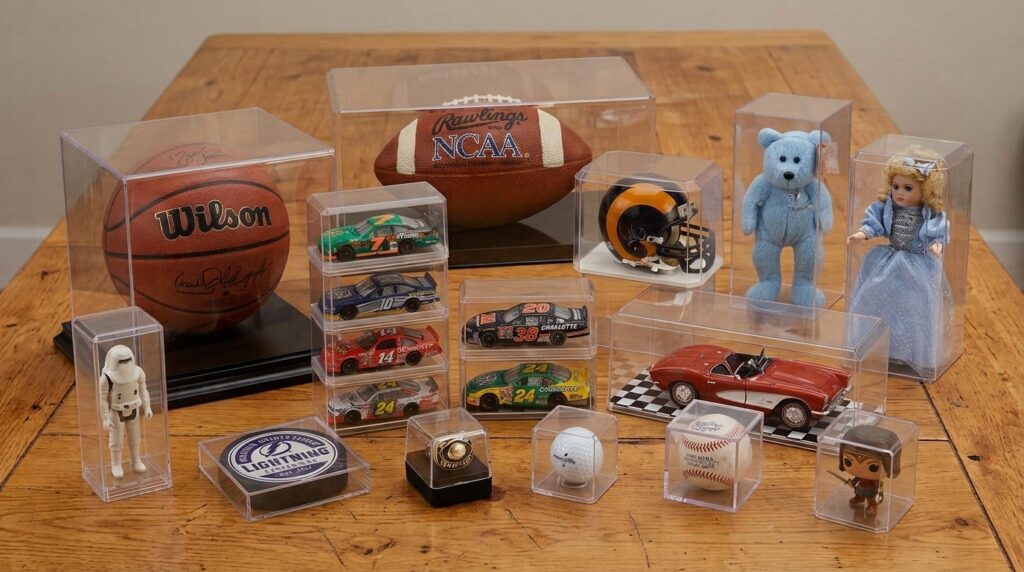
How to Choose a Display Case for Collectibles, From Hot Wheels to Helmets
Most display case listings tell you what a case looks like. Very few tell you whether what you collect will actually fit inside it. That is why learning how to choose a display case for collectibles starts with the interior dimension, the one number on the listing that settles everything else.
Key Takeaways
Interior dimensions decide fit, and they are the figure Pioneer Plastics prints on every display case listing. Exterior dimensions are not published, which matters less than it sounds, because the outside of a case tells you nothing about what goes in it.
A loose 1:64 car needs an interior of 3-1/2″ x 1-3/4″ x 1-5/8″ (SKU 164C-6PK). A 1:18 model needs 13″ x 5-1/2″ x 5″ (SKU 355C). An oversized 1:18 military vehicle, fire truck or hearse needs 15-1/2″ x 7″ x 6″ (SKU 576C).
UV protectant coating is an optional add-on on Pioneer Plastics diecast cases, not a standard feature. A case ordered without that coating is not UV protected.
Cases are sold primarily by the carton, from 2 units for a basketball case up to 208 for an action figure case. Single units come through the Amazon store and distributor partners.
Start With Interior Dimensions, Not Case Descriptions
Interior dimensions are the only measurement that decides whether your item fits. Pioneer Plastics publishes them on every display case listing, so the fastest way to shop is to measure your item at its widest, deepest and tallest point, then compare those three numbers against the interior figure.
Searching by what you collect is easier than searching by dimensions, which is why the table below starts there. Find your item, then check the number.
What you collect
Case (SKU)
Interior dimensions, as printed
Per carton
Category page
1:64 diecast, single loose car
164C-6PK
3-1/2″ x 1-3/4″ x 1-5/8″
132
1/64 Scale
1:64 diecast, row of cars, or a 1/64 hauler
633C
15-5/8″ x 3-5/8″ x 3″
12
1/64 Hauler
1:43 diecast
143C-BB / 143C-BC
6.17″ x 2.59″ x 2.12″
12
1/43 Scale
1:32 diecast
084C
8″ x 3-3/4″ x 3-7/8″
18
1/32 Scale
1:24 diecast
094C
9″ x 4-3/8″ x 4-1/8″
12
1/24 Scale
1:18 diecast
355C
13″ x 5-1/2″ x 5″
8
1/18 Scale
1:18 oversized (military, fire truck, hearse)
576C
15-1/2″ x 7″ x 6″
6
1/18 Scale
Action figures, 3.5″ to 4″
126C-BB / 126C-CB
1 7/8″ x 1 3/8″ x 4 3/8″ tall
208
Action Figures
Mini football helmet
865C
8″ x 6″ x 5″
8
Mini Helmet
Plush collectibles
865CD-Toy
8″ x 6″ x 5″
8
Plush Collectibles
Doll or plush stand
901DS
2 3/4″ x 2 5/8″ x 5 3/4″
12
Plush Collectibles
Baseball
033C
3″ x 3″ x 3″
24
Baseball
Basketball or soccer ball
1010C
9-3/4″ x 9-3/4″ x 9-5/8″
2
Basketball
Softball, also listed for Funko Pop collectibles
042C-SW
4″ x 4″ x 4-1/8″
20
Softball
Hockey puck
133C
3″ x 3″ x 1.05″
12
Hockey Puck
Bobbleheads
048C
3-3/4″ x 3-3/4″ x 8-1/4″
24
Bobble Heads
Championship or class ring
020C
2.17″ x 2.17″ x 1.99″
12
Ring
Golf ball
020CGOLF-BB
2.16″ x 2.16″ x 1.98″
12
Golf Ball
Prices move, so check current per-carton and per-item figures on the category page. Exterior dimensions are not published, so allow a margin if shelf depth is tight.
Which Display Case Fits Your Diecast Scale?
Match the scale printed on the car’s base to the case built for it. Pioneer Plastics organizes its diecast display cases by scale rather than by model, so once you know whether you collect 1:64, 1:43, 1:32, 1:24 or 1:18, the choice is mostly settled.
1:64 and smaller, the Hot Wheels and Matchbox range. A single-car case shows one car and stacks into a wall of cars. The longer 633C does double duty: it holds a line of cars, and that same 15-5/8″ length makes it the 1/64 hauler case, sized for semi tractor-trailer rigs and model trucks. The 1/64 scale cases come in both shapes.
1:43 through 1:24. The middle scales are where bases start to matter, because the car is large enough that the surface under it reads as part of the display. Black bases, clear bases, mirrored bottoms and checkered bottoms are all stocked.
1:18. Larger models are built to be looked at rather than played with, and they are more fragile for it. Single-car cases that close securely are the standard choice, and the 1/18 scale line carries plain, mirrored and checkered versions.
Oversized and Odd-Shaped Models
Oversized 1:18 cases take the models a standard 1:18 case will not. Military vehicles, fire trucks and hearses run longer and taller than a passenger car at the same scale, and the 576C at 15-1/2″ x 7″ x 6″ is built for them.
Farm equipment has its own home: the toy tractor display cases subcategory. For other awkward shapes, Pioneer Plastics says the mini helmet case (865C, 8″ x 6″ x 5″) “can also be used to display other small items, such as collectible figurines or other memorabilia,” as long as the item fits securely. Check the wider sports display case range when nothing in the diecast line has the right proportions.
DIY and Storage Alternatives, and the Tradeoff They Carry
Manufacturer car cases, the molded carry cases sold for children’s play collections, hold a lot of cars in a small footprint and travel well. They store rather than display.
You can also get creative and use a piece of PVC pipe in the right diameter or a fishing tackle box with the correct size cubbies to safely store smaller scale model cars. These options will protect the cars from dust and sunlight, but they do not allow easy viewing. Storage keeps a collection safe. A case keeps it safe while you look at it.
What a Display Case Protects Against, and What It Does Not
A case does three jobs at once: it protects, it stores, and it displays. It solves the first threat below outright, helps substantially with the second and fourth, and only partly with the third. Knowing which is which stops a collector trusting a case to do something it cannot.
UV protectant coating is an optional add-on on Pioneer Plastics diecast cases, so a case ordered without it is not UV protected. If light is the main worry, start with the cases with UV protection and the fuller guidance on protecting memorabilia from sun damage.
Humidity, where a case helps but does not fix.Damp above 75% relative humidity drives rapid corrosion of metals, because the water layer always present on a metal surface grows quickly past that point, per CCI guidance issued in 2017 and revised in 2021. That matters for diecast, which is metal under the paint. A closed case slows air exchange with the room, but it does not dehumidify, so a damp basement stays a damp basement.
Handling, knocks and missing pieces. Children, guests and a passing elbow cause more damage than any slow chemical process, and small items left loose on a shelf have a way of disappearing. A case that closes is the cheapest protection against both, which is why preserving value and showing a collection are one decision.
Plastic vs Glass Display Cases: What Each Does Better
Plastic display cases may be better than glass for several reasons, and the honest version of that comparison is that each material wins on different criteria. Choose by how the case will be handled, shipped, stacked and paid for.
Clear plastic does better on:
Impact. Most glass cases shatter if dropped from more than a few inches, while a plastic case can take a drop of several feet without more than a crack. An accident does not turn the case into the thing that breaks the collection.
Weight. Plastic cases are much lighter, so stacking several or filling one shelf will not overload the display location.
Cost. Glass cases are more costly, because they need special care in production and shipping.
Design flexibility, including beveled edges, integrated bases, and the mirrored and checkered bottoms stocked across the diecast line.
Glass does better on:
Optical clarity. High-quality glass can be perfectly clear, which is why it was the default through the 19th century, when it was the only transparent material available.
Strength in ordinary handling. High-quality glass is reasonably strong and protects collectibles from certain kinds of harm.
For a collector buying more than one or two cases, weight, cost and impact resistance usually decide it. For a single showpiece in a low-traffic room, glass is reasonable. Pioneer Plastics’ crystal clear walls allow you to easily see your collection while keeping it safe from dust and damage, which is the practical ceiling most displays need anyway.
Case Features Worth Choosing Deliberately
Features change how a collection reads, not whether it is protected. These are stocked across the Pioneer Plastics display case categories, and each answers a specific display problem.
Mirrored bottoms show the underside of a car or the back of a figure without buying a second case.
Checkered bottoms suit racing and motorsport collections, where a plain base can look unfinished.
Wooden bases read warmer on a shelf alongside furniture. The 1:64 row case is stocked in a wooden-base version (633CDWOOD).
Black bases and clear bases change the contrast behind the item. Black makes brightly colored pieces pop, clear disappears.
Tilt stands angle an item toward the viewer, which helps on a high shelf.
Stackable designs. The diecast cases are described as durable, stylish and stackable, and that is what lets a growing collection build upward instead of spreading sideways.
Display cases are sold primarily by the carton. Pioneer Plastics is a wholesale company that sells a variety of plastic products, and every listing shows a price per carton alongside a price per item, so both numbers are visible before you order.
Wholesale and bulk. Carton quantities run from 2 units for a basketball case up to 208 for an action figure case, with freight included on orders shipping within the lower 48 states.
Single units. Pioneer Plastics also has an Amazon store as well as a number of distributor partners that sell individual products.
Customization. Size alterations are possible, but only for orders of 50,000 units or more annually, because a size change requires a new mold.
Made in the USA, and in stock. Stock products are molded at the Dixon, Kentucky facility, kept in stock and shipped the same day.
Frequently Asked Questions About Choosing a Display Case for Collectibles
Can clear plastic display cases be stacked safely?
Yes. The diecast cases are described as durable, stylish and stackable, and stacking is how most collectors grow a display without taking more shelf space. Keep heavier and larger cases at the bottom, and avoid a tower tall enough that a knock at the base topples the column.
Does a 1:64 case fit packaged or carded Hot Wheels, or only loose cars?
The 1:64 cases are sized around a loose car. A standard blister card will not fit a 1:64 single-car case, and Pioneer Plastics does not list a case category for carded or blister-pack diecast. The checkable number is the interior: 3-1/2″ x 1-3/4″ x 1-5/8″ on the 164C-6PK, so measure your card against it before ordering.
How do you clean dust off a display case without scratching it?
Use a soft microfiber cloth, never paper towels, which are abrasive enough to leave fine scratches. Avoid ammonia-based cleaners like Windex, which can cloud or craze clear plastic over time. Cleaning rarely beats cleaning gently, which is the argument for a closed case.
Should you use a mirrored bottom or a plain base behind a car?
It depends on what you want the viewer to see. A mirrored bottom reveals the chassis and doubles the apparent depth of the case, which suits a detailed model. A plain, black or checkered base keeps attention on the car itself and reads cleaner in a long row. Collectors showing a full set often mix the two to break up the grid.
Will a sealed display case trap humidity and damage what is inside?
No, and the answer is more reassuring than collectors expect. A closed case slows air exchange with the room, which buffers short-term swings, but it does not dehumidify, so it cannot make a damp room safe. The room is what matters: damp above 75% relative humidity drives rapid corrosion of metals, per CCI guidance revised in 2021, and diecast is metal. Keep cases out of basements, garages and exterior-wall closets, and the case handles the rest.
Find the Case That Fits What You Collect
The interior dimension is the whole decision, and every Pioneer Plastics display case listing publishes it. Measure what you collect, find the matching scale or sport, and order by the carton. Running a shop, trophy business or hobby store? Apply to become a distributor or retailer for Pioneer Plastics containers and collectible display cases.
Matchbox® and Hot Wheels™ are registered trademarks of Mattel, Inc. Pioneer Plastics, Inc. is not affiliated with or endorsed by Mattel, Inc. All trademarks are the property of their respective owners and are used for identification purposes only.
The information provided in this content is for general informational purposes only and should not be considered professional advice. It is advisable to consult with a qualified industry professional before taking any action based on this information. The team at Pioneer Plastics is here to assist you with any questions you may have.
In today’s rapidly evolving market, plastic injection molding innovations are significantly contributing to sustainability and efficiency. The plastic injection molding industry is undergoing a transformative
The custom injection molding process starts with a conceptualized design and ends with a uniquely manufactured product. If your product needs to be aesthetically pleasing