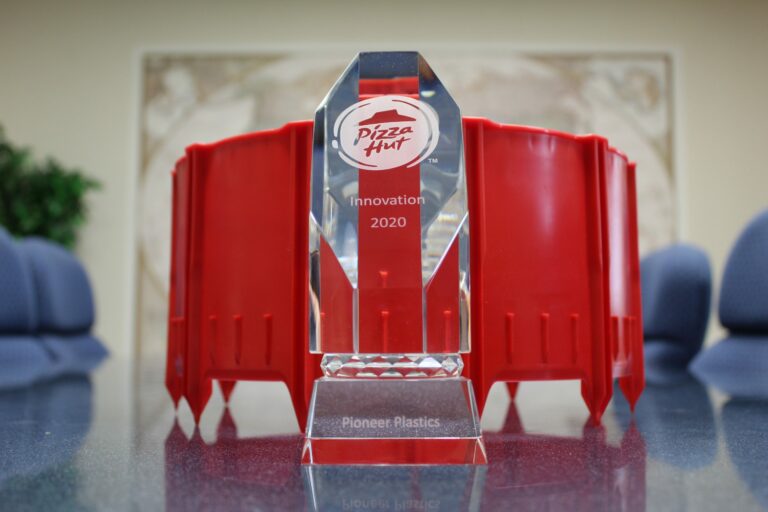
Pioneer Plastics Wins Pizza Hut Europe’s Innovation of the Year Award
DIXON, Kentucky – Pioneer Plastics was selected as Pizza Hut Europe’s Innovation of the Year award recipient for the creation of the Pizza Delivery Stand,


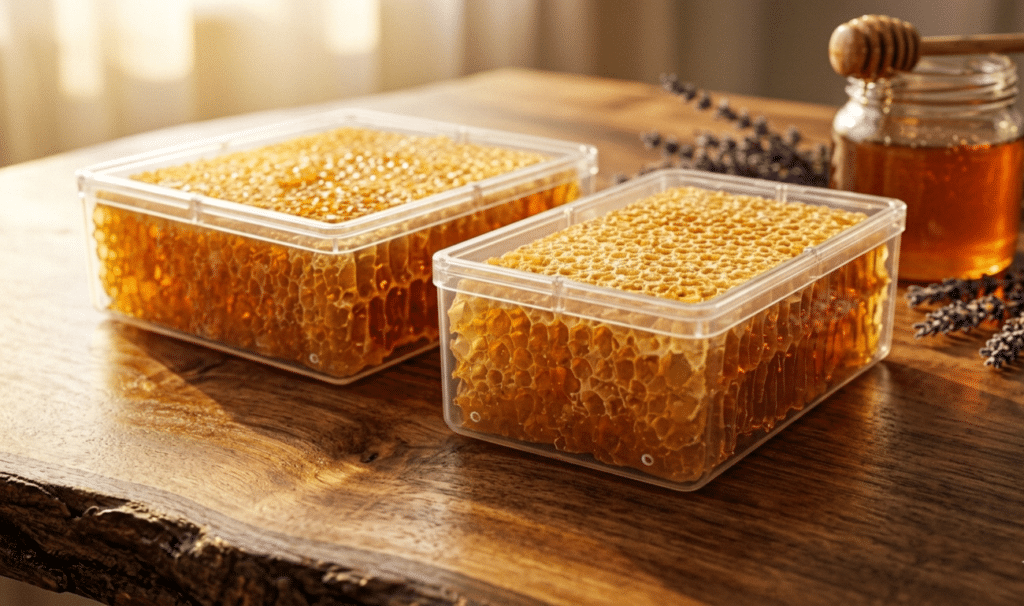
Picking the wrong cut comb container is the difference between a clean retail product and a leaky, shifting box that looks like an afterthought on the shelf. Choosing among cut comb honey container sizes comes down to three variables: your frame depth, how thick your comb is drawing, and the retail price point you want to hit. This guide maps each variable to the right Pioneer Plastics SKU, including the recently added value-tier 156C-N and 155C-N variants, so you can stock the container that actually fits your operation.
Container size controls three things at once: how the comb seats in the box, how much honey leaks during transport, and how the finished product reads to a buyer on the shelf. Get the size wrong in either direction and the product suffers.
Three failure modes show up most often when the container does not match the comb:
The fix is matching the SKU to the comb you are actually producing, not the comb you wish you were producing. If you also need the broader packaging workflow that surrounds this decision (cutting, draining, labeling, and getting to shelf), the full beekeeper’s guide to packaging cut comb honey for retail sale covers the whole process.
Pioneer Plastics produces three cut comb honeycomb containers: a standard full size (156C-N), a shallower full size for thinner comb (091C), and a half size (155C-N).
| SKU | Size class | Capacity | Interior dimensions | Carton | Best for |
| 156C-N | Full size | 14 oz | 4-1/4″ x 4-1/4″ x 1-3/8″ | 100 | Standard 4×4 sections from shallow or medium frames |
| 091C | Full size (shallower) | 11.5 oz | 4-5/16″ x 4-5/16″ x 1-1/8″ | 120 | Thinner / foundationless comb |
| 155C-N | Half size | 9 oz | 4-1/4″ x 2-1/8″ x 1-9/16″ | 160 | Smaller sections, lower price points, partial frames |
Each carton ships same day with free freight to the lower 48 states. The carton counts above are the standard pack quantities for distributor and wholesale buyers. Detailed dimensions and current carton pricing are listed on each SKU’s product page.
The 156C-N full-size cut comb honeycomb container is the SKU most cut comb producers should reach for first. It holds a standard 4×4 section, has a 14-ounce capacity, and has a 1-3/8″ interior depth that matches cleanly drawn comb from shallow or medium supers. The interior footprint is 4-1/4″ x 4-1/4″, and it ships in a 100-count carton.
Pick the 156C-N when:
The 156C-N is the current version of Pioneer Plastics’ best-selling full-size cut comb box, and it uses a friction-fit lid for a secure, tight closure. It is also the closest match to what most US bee supply retailers list as their standard 4×4 cut comb box, so beekeepers transitioning from another supplier usually find it the easiest swap. If you are moving over from an older or different box, confirm your typical comb section seats cleanly in the 4-1/4″ footprint before committing to a full carton.
The 091C cut comb honeycomb container holds a standard 4×4 section like the 156C-N, but the interior is shallower at 1-1/8″ instead of 1-3/8″. That quarter-inch difference matters more than it sounds: it keeps thinner comb pressed against the lid for a clean retail presentation instead of letting it float in a half-empty box.
Reach for the 091C in two specific situations:
If your comb consistently fills a 1-3/8″ interior, the 156C-N is the simpler choice. The 091C exists for the seasons and the frame styles where it does not.
The 155C-N half-size cut comb container holds roughly 9 ounces of comb honey in a 4-1/4″ x 2-1/8″ x 1-9/16″ interior. It is the SKU to keep on hand when a full-size 4×4 section is more than your customer needs or more than your frame yielded.
Three use cases drive most half-size purchasing:
Pioneer Plastics added a half-size box to the line in direct response to beekeeper requests. Smaller frames, partial harvests, and lower-price retail venues all created demand for something below the standard 4×4, and the half-size container is what answered it. The 155C-N is the current version, and it shares the same secure friction-fit lid as the 156C-N.
Frame yield is the math that drives how many containers you actually need to order. A shallow frame produces a predictable count of sections; a medium frame yields more but with more variability; deep frames are not used for cut comb at all.
Typical yields per frame:
A practical example: if you run 10 shallow frames of cut comb and target the full-size 156C-N, you will need roughly 40 containers to package the harvest. A standard 156C-N carton holds 100 units, so one carton covers about two and a half harvests at that scale. If you cut half of those frames into half-size 155C-N sections instead, you would order roughly 20 full-size and 40 half-size containers
Frame style affects yield too. Wedge-top frames produce a slightly narrower cut and may not perfectly fill a 4×4 container, while split-top, grooved-top, and solid-bottom frames generally produce cleaner cuts that fill the box. If you are buying both sizes, lean toward the half-size 155C-N for any frames where you expect imperfect or partial sections.
Cut comb honey commands a premium over extracted honey because the comb itself is the product. USDA reports the average US honey price at $2.69 per pound for 2024, while cut comb honey is categorized as a specialty product that earns a meaningfully higher per-pound return. Container size is the lever that decides which price band you capture.
Typical retail price ranges by size:
Stocking both sizes is the strategic play. Full-size sections capture the buyer who came specifically for cut comb. Half-size sections capture the buyer who picked up a jar of extracted honey and grabbed a $8 piece of comb as an add-on. That second buyer does not exist at a $20 price point.
For bee-supply retailers stocking containers for resale, the same logic applies in reverse. Beekeepers visiting your shop manage the same retail spread their customers do, and they will buy whichever container matches what they expect to sell. Carrying both the full and half sizes side by side.
The US standard cut comb container holds a 4×4 inch section with an interior of roughly 4-5/16″ x 4-5/16″ x 1-3/8″ and a capacity around 14 ounces. Pioneer Plastics’ full-size SKU is the 156C-N, with a 4-1/4″ x 4-1/4″ x 1-3/8″ interior. The half-size 155C-N measures roughly 4-1/4″ x 2-1/8″ x 1-9/16″ and holds about 9 ounces.
A shallow frame produces about 4 full-size 4×4 sections or roughly 8 half-size sections. A medium frame yields 4 to 6 full-size sections or up to 10 half-size sections with careful cutting. Deep frames are not recommended for cut comb honey because the comb is too heavy and fragile to handle cleanly.
A full-size box holds a 4×4 section of comb at roughly 14 ounces and sells in the $13 to $25 retail range. A half-size box holds a 4×2 section at roughly 9 ounces and sells in the $6 to $12 range. The half size is built for partial frames, lower price points, and impulse-purchase venues like farm stands and gift shops.
Match the container to three things: your frame depth, the typical thickness of your drawn comb, and the price point you want to hit. Standard-thickness comb from shallow or medium frames goes in the 156C-N. Thinner comb from foundationless frames or short nectar flows fits better in the shallower 091C. Partial frames, smaller sections, or lower-price retail placements call for the 155C-N half size.
Cut comb does not draw to a uniform thickness across every frame, season, and frame style. A 1-3/8″ interior (like the 156C-N) suits standard cleanly drawn comb. A 1-1/8″ interior (like the 091C) is designed for thinner comb so the section stays seated against the lid instead of floating in a half-empty box.
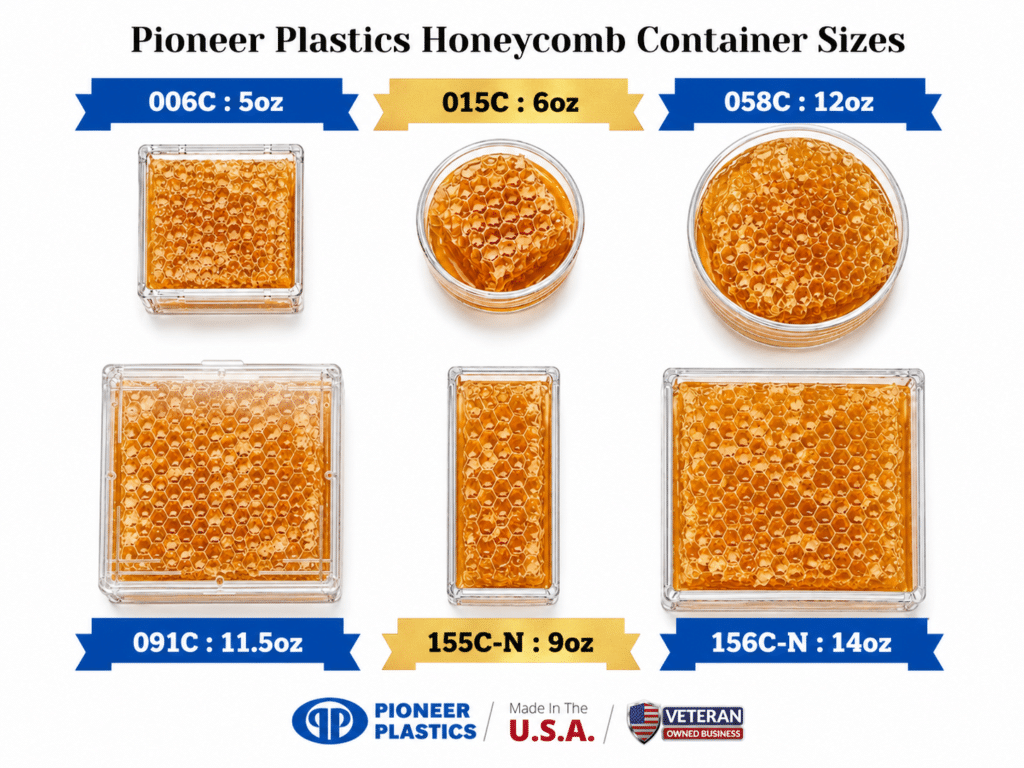
For comb that does not fit a standard 4×4 cut, Pioneer Plastics also stocks three smaller honeycomb category SKUs: the 006C quarter-size square, and two round containers (the 015C and the 058C) sized for irregular pieces and trim. These are not cut comb boxes in the traditional sense, but they belong to the same product family. Browse the honeycomb container category to see all six SKUs side by side.
All Pioneer Plastics cut comb containers are injection molded in Dixon, Kentucky and ship from the same facility with free freight to the lower 48 states, so a beekeeper or distributor can stock the full lineup, from a single supplier. Apply for the wholesale distributor program if you carry cut comb supplies for other beekeepers, or contact Pioneer Plastics directly for carton pricing and lead times.
DIXON, Kentucky – Pioneer Plastics was selected as Pizza Hut Europe’s Innovation of the Year award recipient for the creation of the Pizza Delivery Stand,

Plastic overmolding is a modern manufacturing technique where a softer, flexible polymer is molded over a rigid base material, bonding them into a single, high-performance

Whether you’re about to ramp up existing production or add a new product line, you’re probably experiencing a mixture of excitement and apprehension. You may