

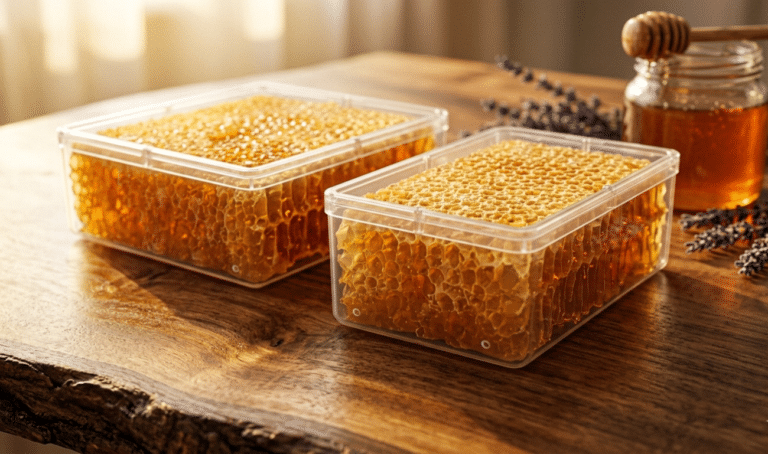
Cut Comb Honey Container Sizes: How to Pick the Right Size for Your Apiary
Picking the wrong cut comb container is the difference between a clean retail product and a leaky, shifting box that looks like an afterthought on
DISCOVER OUR NEWLY RELEASED COLLECTIBLE DISPLAY CASES! SHOP NOW
Shop by brand & type
UV-filtering display cases that guard collectibles, documents, and retail goods against sun damage and discoloration.
Browse UV-protected cases →Display cases packaged for retail shelves — clamshell, boxed, and custom-printed options ready to scan and sell.
Browse retail-ready cases →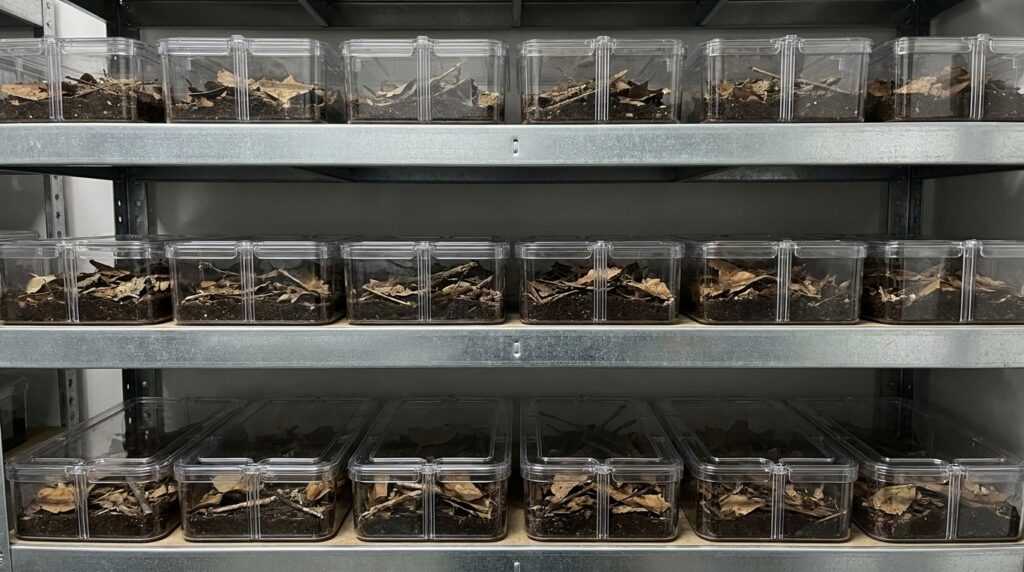
Most guides to feeder insect containers are written for someone keeping one colony on a shelf. This one is written for the person buying by the carton: the feeder producer, the isopod and springtail grower, the breeder shipping livestock every week. At that scale the question stops being what works and becomes what it costs, what it costs to standardize, and what changes when a dozen bins becomes two hundred.
At carton quantity, clear culture containers run from roughly $1.55 to $25.34 per unit depending on size, and the carton total is the number that actually hits a purchase order. Pioneer Plastics publishes both figures for every square container it molds, which is rare in this category.
Pioneer Plastics molds these containers at its own plant in Dixon, Kentucky. The company is veteran owned and family owned, and every container below is made in the USA and sold by the carton.
The table below is the published square plastic container line in lift-off lid formats, sorted by interior depth, with inner dimensions, carton quantity, and price per item taken directly from the category page. Carton cost is those two published figures multiplied.
| SKU | Inner dimensions | Carton qty | Price per item | Carton cost |
|---|---|---|---|---|
| 048C | 3-3/4″ x 3-3/4″ x 8-1/4″ | 24 | $7.47 | $179.28 |
| 047C | 3.8″ x 3.8″ x 7″ | 24 | $5.50 | $132.00 |
| 036C | 2-3/4″ x 2-5/8″ x 5-3/4″ | 40 | $2.81 | $112.40 |
| 044C | 4″ x 4″ x 5″ | 18 | $5.49 | $98.82 |
| 040C | 3.8″ x 3.8″ x 4.1″ | 36 | $4.65 | $167.40 |
| 295C | 12-5/16″ x 9-1/16″ x 4″ | 6 | $21.55 | $129.30 |
| 083C | 7-13/16″ x 3-13/16″ x 3-7/8″ | 24 | $5.85 | $140.40 |
| 395C | 12-1/2″ x 10-1/16″ x 3-13/16″ | 4 | $25.34 | $101.36 |
| 195C | 10-5/8″ x 7-5/8″ x 3-3/4″ | 6 | $19.65 | $117.90 |
| 079C | 7-7/16″ x 5-5/16″ x 3-3/4″ | 18 | $10.23 | $184.14 |
| 028C | 3-3/4″ x 3-3/4″ x 3-1/16″ | 48 | $2.75 | $132.00 |
| 149C | 7-3/8″ x 3-11/16″ x 3″ | 48 | $5.57 | $267.36 |
| 398C | 11-3/4″ x 4-7/8″ x 2-7/16″ | 12 | $14.03 | $168.36 |
| 049C | 6-3/4″ x 4-13/16″ x 2-3/8″ | 40 | $4.94 | $197.60 |
| 160C | 8-3/8″ x 2-3/4″ x 2-3/8″ | 100 | $4.02 | $402.00 |
| 155C | 4-5/16″ x 2-1/4″ x 1-3/4″ | 160 | $1.55 | $248.00 |
| 182C | 6-3/4″ x 3-3/16″ x 1-5/8″ | 60 | $4.73 | $283.80 |
| 082C | 6-3/4″ x 3-3/16″ x 1-5/8″ | 60 | $4.34 | $260.40 |
| 030C | 5-7/16″ x 4″ x 1-1/2″ | 85 | $2.87 | $243.95 |
| 062C | 5-1/4″ x 5″ x 1-3/8″ | 108 | $3.81 | $411.48 |
| 156C | 4-5/16″ x 4-5/16″ x 1-3/8″ | 100 | $2.34 | $234.00 |
| 091C | 4-5/16″ x 4-5/16″ x 1-1/8″ | 120 | $2.35 | $282.00 |
| 092C | 4-5/8″ x 4-5/8″ x 1-1/8″ | 132 | $2.77 | $365.64 |
| 006C | 2-7/8″ x 2-7/8″ x 1-1/16″ | 135 | $1.60 | $216.00 |
Price per item is the number to carry into your own cost model, because it is what scales with bin count.
A culture container is production equipment. Its job is to keep a colony contained, visible, and washable, and to be identical to the two hundred containers sitting next to it.
That shows up in what a buyer optimizes for.
Cleanup crew cultures, meaning the isopods and springtails sold into bioactive setups to break down waste, hold moisture for weeks at a time, so they need a container that retains humidity and lets you read population density through the wall without opening the lid. Feeder colonies get opened constantly, so escape resistance and fast access matter more than moisture retention.
Isopod and springtail growers are also selling the culture itself, which makes clarity a sales feature as much as a husbandry one. A buyer who can see a dense colony through the side of a container does not need to be talked into it. For a species level walkthrough of that trade off, our guide to choosing clear containers for isopod growers and sellers goes deeper on enclosure selection than this post does.
Injection molded containers are rigid and hold their wall geometry and lid fit through repeated washing. Thermoformed deli cups are thin, flexible, and inexpensive, and they deform with heat and handling. For a container that stays in service for years, rigidity is a purchasing criterion rather than a detail.
Rigid injection molded containers earn their price when:
Thin thermoformed cups are the better call when:
There is no version of this where one type wins outright. A grower shipping two hundred springtail starters a month should be buying disposable cups for the shipments and rigid containers for the colonies that produce them. Pioneer Plastics manufactures food grade plastic containers for the second job, with crystal clear walls and a square footprint built to stack.
Square containers win on shelf math. A square footprint tiles a shelf with no wasted gaps, so you can count positions instead of measuring them, and that advantage compounds across a rack. Round containers give up the corners, and at two hundred bins those corners add up to real shelf space.
Round still earns its place in two situations.
Pioneer Plastics groups both shapes under containers for insect, isopod, and invertebrate cultures, which mixes square and round SKUs because both have a job in a working breeding room.
Carton buying wins on cost per unit and on consistency. Retail multipacks, repurposed storage totes, restaurant supply cups, and purpose built rack systems each solve a real problem, and each has a point where it stops making sense for a growing operation.
Pioneer Plastics sells in full carton lots, which is the trade that makes the published per-unit pricing possible. Buyers who need single units or small quantities can go through the Pioneer Plastics Amazon store or one of the distributor partners that carry the line.
Demand on feeder and cleanup crew producers tracks the wider pet market. APPA’s 2026 State of the Industry Report put U.S. pet industry expenditures at $158 billion in 2025, with $165 billion projected for 2026. Ingrid Chu, APPA’s Vice President of Research Insights, described the pattern as a broadening base of pet ownership reaching from younger first time buyers to Gen X households adding species. Growers feel that as more orders, not as a headline.
The container decisions that are invisible at ten bins become the operating constraint at two hundred.
Pioneer Plastics groups the SKUs suited to this work under reptile breeding containers, which is a faster starting point than reading the full catalog. Our guide to sizing enclosures across a jumping spider’s life stages works through the same upgrade problem for a single species.
Most culture losses trace back to the container rather than the husbandry. Lid fit, gas exchange, and contamination account for the majority of them, and all three get harder to manage as bin count rises.
Only at volume. Size alterations are possible for orders of 50,000 units or more annually, because a size change means building a new mold. Below that threshold, the practical move is choosing the closest published size and standardizing your operation around it.
No. They ship as molded, so growers add ventilation themselves to match the species and the moisture level they are running. Plan it as a batch task when you are venting a full carton rather than a single bin.
Generally not. A hinged snap closure is convenient for packaging and display, but the lid cannot be removed, drilled as a batch, or swapped between bins, and hinged formats tend to be shallow. For colony housing, a separate lift-off lid is the better choice, which is why the hinged SKUs in the square line are not in the table above.
Insects that are not poisonous and not disease conveying are generally mailable when properly prepared, while all spiders are nonmailable under USPS Publication 52, with a narrow exception for scorpions. Confirm the current rules and your carrier’s own packaging requirements before you build a shipping process around any container.
Often not, and that is worth saying plainly. At a dozen bins the per-unit savings will not cover the cost of holding stock you do not need yet, and a distributor or the Amazon store is the better route. The math changes once you standardize on one or two sizes and start replacing containers on a schedule instead of one at a time.
Container decisions get harder to reverse as bin count grows, which is a good argument for making them deliberately while the operation is still small enough to change course. If you are buying for resale, the distributor application is the place to start. If you need something the published line does not cover, contact the Pioneer Plastics team with your volumes and specifications.
The information provided in this content is for general informational purposes only and should not be considered professional advice. It is advisable to consult with a qualified industry professional before taking any action based on this information. The team at Pioneer Plastics is here to assist you with any questions you may have.
Picking the wrong cut comb container is the difference between a clean retail product and a leaky, shifting box that looks like an afterthought on
Plastic injection molding is a popular manufacturing method used to produce a wide variety of products across industries. From consumer goods to industrial components, the
Choosing a new injection molding partner is one of the highest-stakes sourcing decisions a product team makes, because the wrong molder shows up later as